
When people think about Lombok, most of them immediately imagine beaches, surfing spots, and tropical sunsets. But beyond the coastline and resorts, Lombok also holds a rich cultural treasure that has survived for centuries — the beautiful art of Sasak weaving.
Known locally as tenun Sasak, this traditional weaving art is more than just fabric-making. For the Sasak people, the native ethnic group of Lombok, weaving is deeply connected to identity, tradition, spirituality, and family life. In many villages, weaving is not simply a hobby or business. It is a way of life.
One of the best places to experience this tradition is in the villages of Sukarara and Sade in Central Lombok. These villages are famous for preserving the original weaving culture passed down from generation to generation.
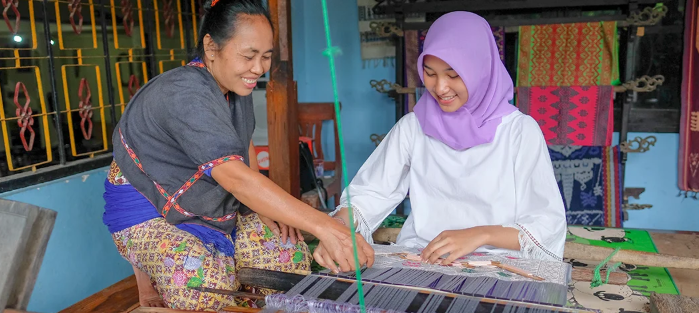
Walking through the villages feels like stepping into a living museum. You can hear the rhythmic sound of wooden looms, see colorful threads hanging outside traditional houses, and watch local women carefully weaving intricate patterns by hand.
What makes Sasak weaving truly unique is the meaning behind the process itself. In traditional Sasak culture, girls learn weaving from a very young age, often from their mothers or grandmothers. In the past, weaving skills were even considered a requirement before marriage. A woman was expected to weave several pieces of cloth before she could officially marry. This tradition symbolized patience, maturity, and responsibility.
The weaving process is also incredibly detailed. Everything starts from natural materials like cotton and kapok fibers. The threads are spun manually and dyed using natural ingredients from plants, roots, and leaves.
Then comes the hardest part — weaving each thread carefully on traditional looms. Depending on the complexity of the pattern, a single cloth can take weeks or even months to complete.
The motifs found in Sasak weaving are not random decorations. Every pattern tells a story. Some designs are inspired by nature, mountains, birds, flowers, and daily village life. Others carry spiritual meanings influenced by local beliefs and Islamic culture.
One of the most famous motifs is the Subahnale pattern, named after the Arabic phrase “Subhanallah.” This sacred motif is traditionally woven only by older women and is believed to carry spiritual value.
Another interesting thing about Sasak weaving is how the tradition survives in modern times. Even with factories and modern textile machines becoming more common, many Sasak weavers still choose traditional methods.
The fabrics are handmade, environmentally friendly, and full of cultural meaning. This is one reason why tourists love buying Sasak woven fabrics as souvenirs — not only because they are beautiful, but because every piece feels personal and authentic.
Today, Sasak weaving has become one of Lombok’s most valuable cultural attractions. Visitors can learn directly from local artisans, try weaving themselves, and understand the stories hidden behind every thread.
In a world filled with fast fashion and machine-made products, Sasak weaving reminds people that true craftsmanship still exists. It is slow, meaningful, and deeply connected to human history. And perhaps that is exactly what makes it so special.